I think if your state is complex enough to divide it up, you should put that in a live_component as they can manage their own state, otherwise its normally best in a function component. I think this is where your head was already at anyway.
Here is a layout in a recent project that is similar in structure to yours, just as an example I guess.
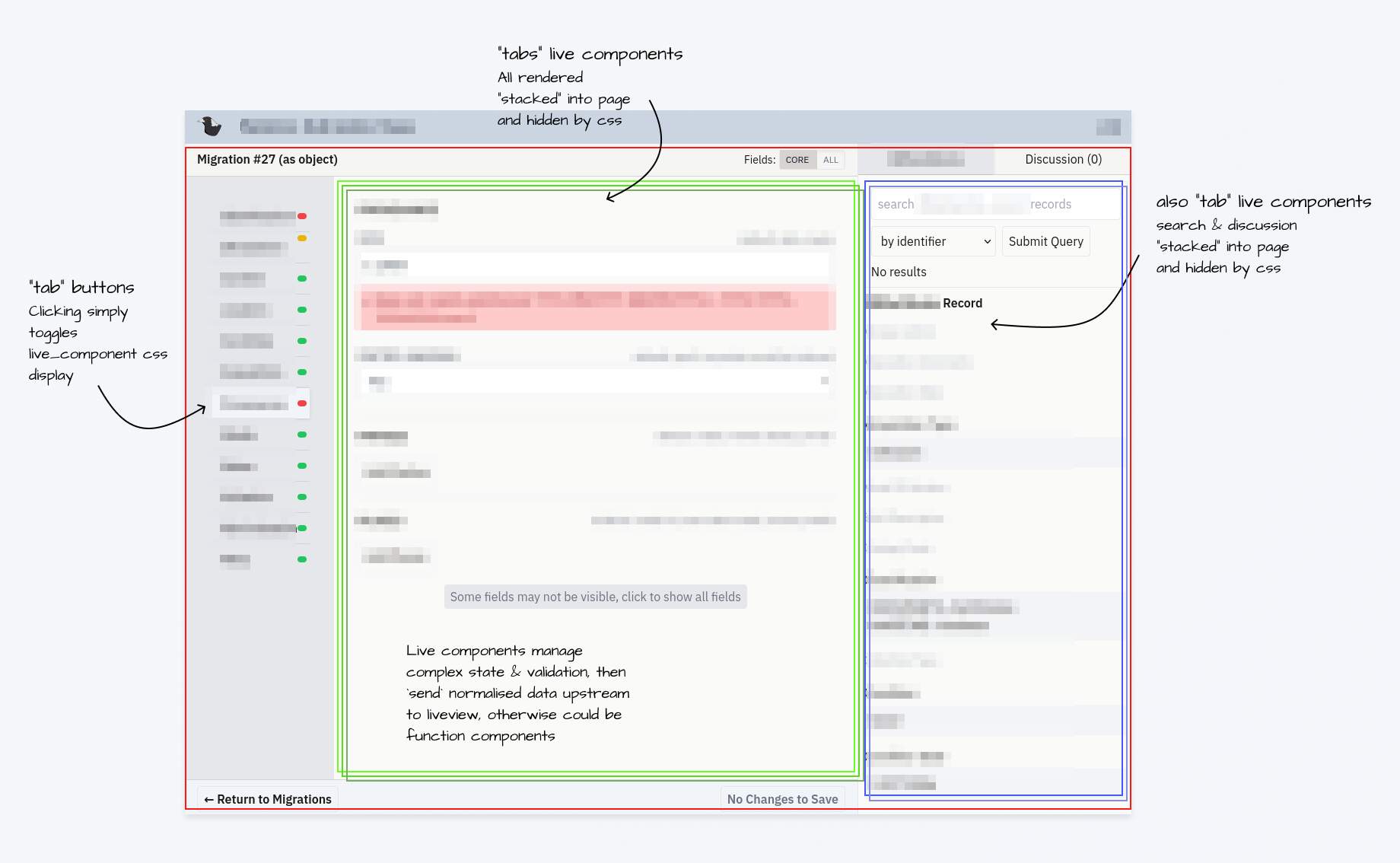
In this, each “green” live component manages its own structs & form – specific to that live component and passes data back up to the parent. This could all be done with function components but the main live view would get very bloated. Technically the tab bar is a function component.
So I think this is a spin on your “after”, where instead of nesting the tab content inside a tab component, I cut out the middle man. The “which tab are we on” state isn’t sufficiently complex to need a separate live component in my case. I have used this kind of layout many times on complicated multi-stage forms.
All the tabs are rendered into the page at once and just display: hidden in this case. This does have an impact on the initial page load time if the data structure (well, if the html derived from the datastructure) is complex, so if you can, I would try and only render one at a time. In this case it’s simpler to just load them all instead of passing data up and down and re/de-hydrating all the time and it’s an internal tool so the extra 100-300ms initial render time isn’t too problematic.
So I guess my advice is to start with functional components until the state being tracked is complicated enough that you want to modularise it; at which point you can put it into its own live_component and focus your state changes through messages. This send pattern is really great when you want to only send “valid” data back up to the parent as you can localise all the validation cruft to section-specific changesets & “views” (live_components).
Hope some of that is helpful?
But if im piping the events through the component to the liveview, does it even make sense for it to be a live_component, or could I just as well use a function component? (im a little lost on when to use what, and for what purpose)
If I understand what you mean here, I would not pipe the “handle_params” event down to the component, just use that to determine which to render?