I have some better news: Recently I was introduced to the Aja library, which implements multiple of data structures focused on performance. Its A.Vector is a persistent immutable array implementation, written fully in Elixir.
I wrapped A.Vector with the Arrays.Protocol (which was a breeze as Aja already exposes a very rich API  ), and benchmarked them against the other implementations.
The results are amazing! 
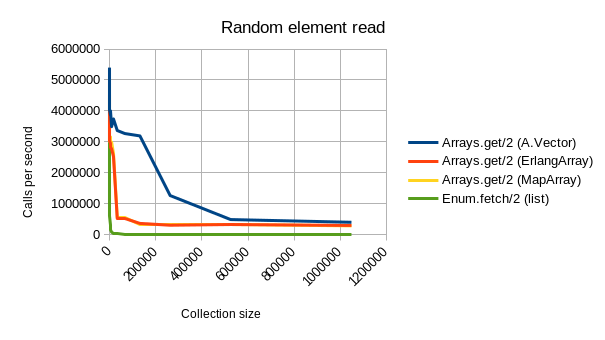
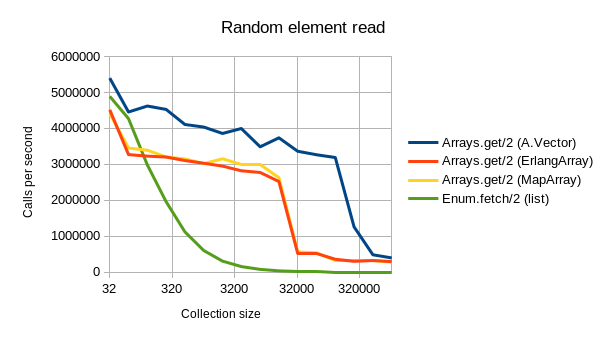
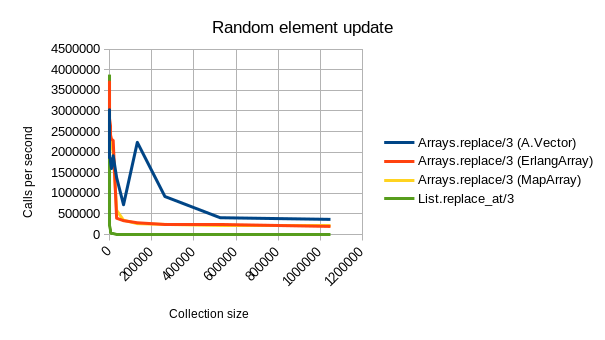
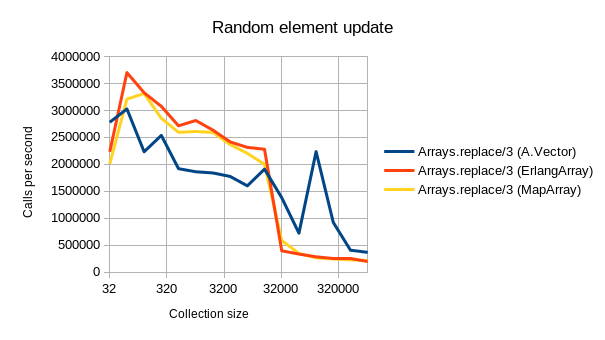
Aja’s implementation is fast. As can be seen from below benchmarking graphs, A.Vector beats the other alternative datatypes outright in most common tasks:
- Random reads are much faster regardless of array size. (and remain super fast even for very large arrays!)
- Random updates are slightly (~20%) slower than using an MapArray or ErlangArray for arrays with less than ~2^1 elements. After this, A.Vector is often much faster. (I do not yet know what causes the odd spike at 2^17 where A.Vector is super fast.)
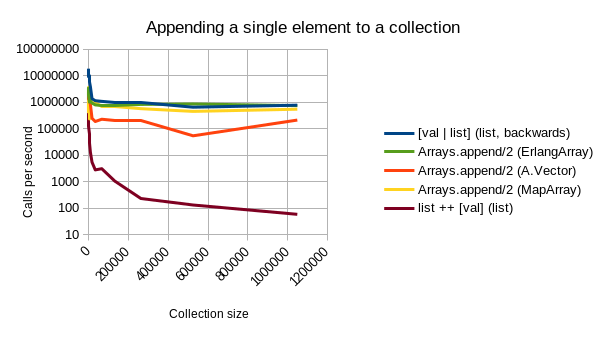
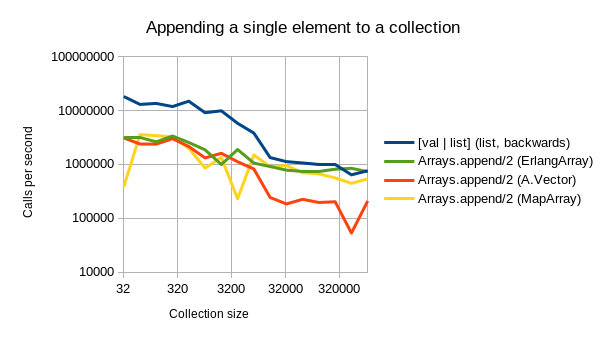
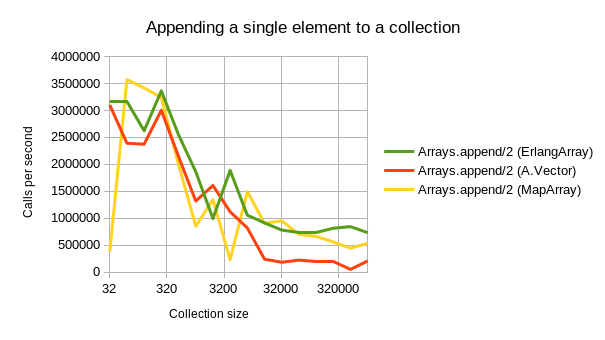
- Appending a single element is similarly performant to the other implementations. At higher sizes, it keeps up with ErlangArray (where MapArray becomes much slower.)
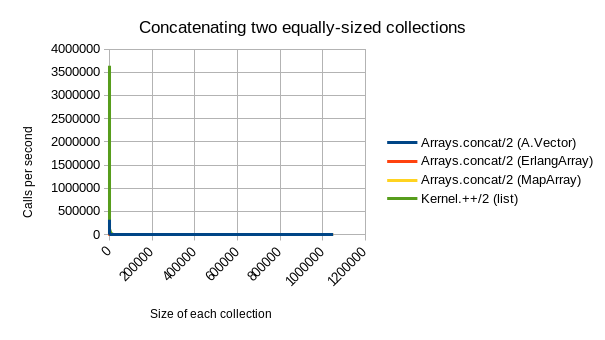
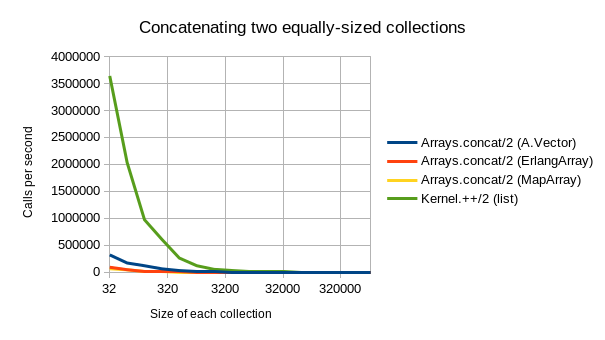
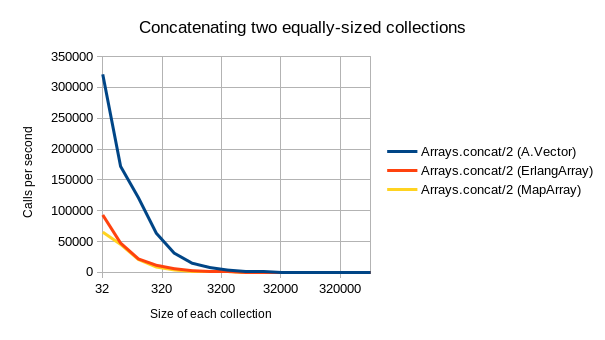
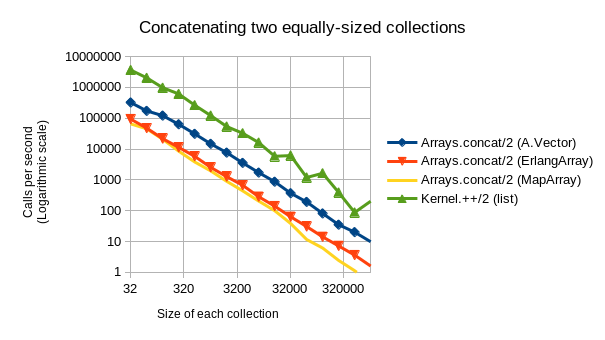
- Concatenating is where
A.Vectoralso really shines: It is roughly 5x(!) faster than ErlangArray and MapArray, regardless of collection size. It is only outclassed by plain lists (which are again ~5x faster for concatenation, but much (i.e. asymptotically) slower for all of the other three operations).
You can find ArraysAja on GitHub in a separate library, of which v0.1.0 has been published to Hex.PM.