
dimamik
Feline - PoC for pipecat-inspired real-time voice and multimodal AI pipelines in Elixir
Hi! I’ve been working with Pipecat in Python for quite a while now, and while it’s effortless to set up, when building AI voice agents at scale, it starts to show its limitations. Pipecat has trouble with:
- concurrency - Pipecat uses asyncio, so only IO is concurrent. Elixir’s version is built on top of processes.
- frame reliability - If individual frame processor in pipecat crashes - it’s really tricky to recover it. With beam - we have it for free.
- error handling - Pipecat swallows errors, since it’s hard to propagate them across async calls. Monitoring can be tedious. In Elixir, we could use built-in OTEL spans.
- fault tolerance - crashes are not isolated, one crash can affect the whole system.
- simplicity - Since Python is OO, it’s especially challenging to trace state changes across all of that. And building on top of pipecat is extremely error-prone and difficult. Race conditions are inevitable.
Since I very much appreciate Elixir for its design and simplicity, especially for building these kinds of systems, I thought it might be a great idea to port pipecat to it.
Before starting on the implementation myself, I thought it might be worth it to create a PoC on how this could look like with Claude and ask all of you guys what you think. I don’t ask you to review the code itself yet - just the general concepts.
So here is what Claude (with a little guidance from me) came up to:
https://github.com/dimamik/feline
And here’s what the pipeline could look like:
Pipeline.new([
  {Feline.Processors.VADProcessor, start_secs: 0.2, stop_secs: 0.8},
  {Feline.Services.Deepgram.StreamingSTT, api_key: deepgram_key, sample_rate: @sample_rate},
  {Feline.Processors.ConsoleLogger.UserInput, []},
  {Feline.Processors.UserContextAggregator, context_agent: pair.agent},
  {Feline.Services.OpenAI.StreamingLLM, api_key: openai_key, model: "gpt-4.1-mini"},
  {Feline.Processors.AssistantContextAggregator, context_agent: pair.agent},
  {Feline.Processors.ConsoleLogger.BotOutput, []},
  {Feline.Processors.SentenceAggregator, []},
  {Feline.Services.ElevenLabs.StreamingTTS,
    api_key: elevenlabs_key, voice_id: voice_id, sample_rate: 24_000},
  {Feline.Processors.AudioPlayer, sample_rate: 24_000}
])
And here’s a demo on how the above works:
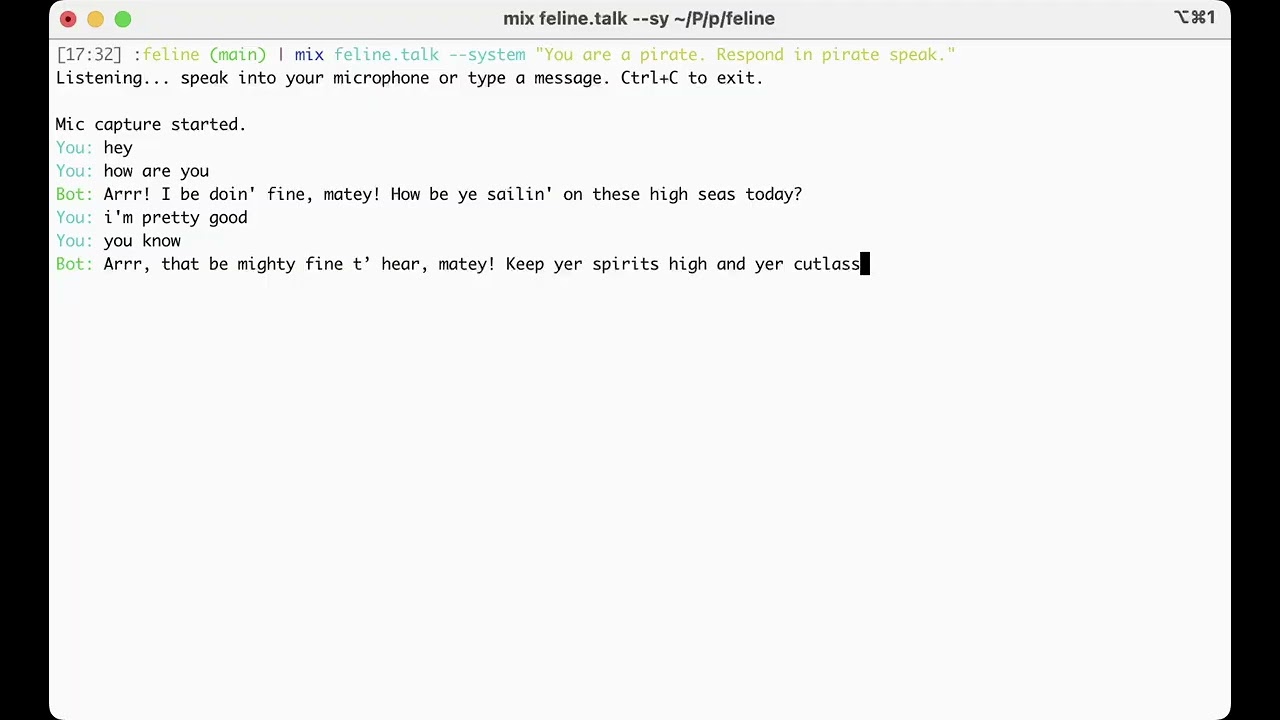
It’s a little similar in spirit to Membrane, but it aims at preserving very close compatibility with the original Pipecat library. Nevertheless, I already talked too much, so now I want to hear what you all think!
Popular in RFCs








Other popular topics








Categories:
Sub Categories:
Forums
Popular Tags
- #ecto
- #liveview
- #troubleshooting
- #learning-elixir
- #deployment
- #library
- #erlang
- #testing
- #genserver
- #mix
- #absinthe
- #remote-other
- #otp
- #plug
- #how-to-question
- #macros
- #postgres
- #channels
- #elixirconf
- #exunit
- #discussion
- #code-sync
- #javascript
- #podcasts
- #onsite
- #dialyzer
- #docker
- #authentication
- #umbrella
- #full-time-contract
- #podcasts-by-brainlid
- #ecto-query
- #elixir-ls
- #phoenix_html
- #iex
- #blog-post
- #graphql
- #genstage
- #ai
- #websockets
- #supervisor
- #advent-of-code
- #elixirconf-us
- #distillery
- #processes
- #forms
- #api
- #metaprogramming
- #security
- #performance
Our Sponsors

Build Elixir applications with speed and confidence.

Supporting innovation across the BEAM ecosystem.

We build reliable cloud platforms for business-critical systems.

Catch errors, track performance, monitor hosts and more.

Error tracking for Elixir devs who love to ship. Start your free account.

Producing high quality Elixir screencasts since 2017.

Enabling companies to succeed by building software people love.

The deployment platform built for Elixir: PaaS ease, VPS control.

The team behind Membrane, Popcorn, LiveDebugger. Available for hire.

Courses that'll move you from confusion to "Aha, now I get it!"