To point a few differences:
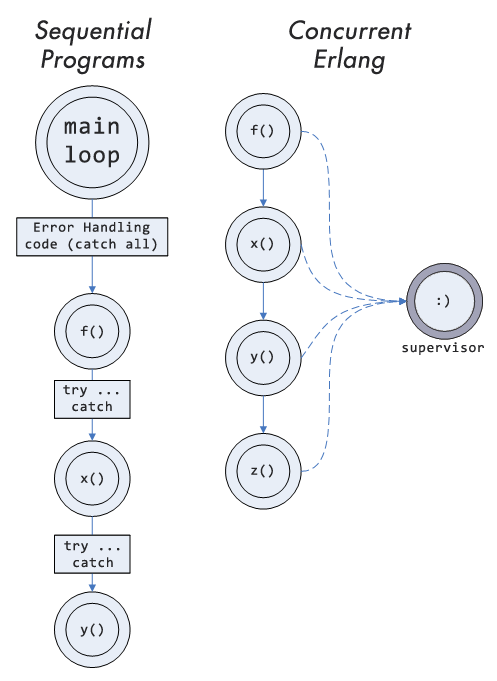
- “Let it crash” helps centralize the error handling in a supervisor process, rather than have it spread around your business logic. This diagram in An Open Letter to the Erlang Beginner (or Onlooker) represents this:
-
All resources are owned by a process in Erlang, and the VM guarantees clean-up of resources once the process dies. In Java, Python, etc., if your response handler opens a file then throws a NullPointer at some random location later, the framework’s exception handler will catch it and the application will seem OK… until it runs out of file handles after this happens too many times. I’ve seen a Twisted app lock up hard because of this. So you have to be more careful with your error handling, and spread try/catch over the business logic.
-
This extends to other types of resources, for instance registered names, DB connections, or locks of all kinds. In most languages, if you hit a problem where threads are grabbing DB connections then throwing an exception without releasing the connection, your app will quickly run out of connections and die. In Erlang the connection (a process) can keep a monitor on the owner (another process), and release itself as soon as the owner dies, no matter the reason. So the robustness of your application depends on the correctness of the DB connection’s code, which is rather small, rather than depending on the correctness of every single request handler that uses a DB connection. In the Erlang world this is called the error kernel, and you want to keep it as small as possible.