
AstonJ
What is your testing philosophy?
In the Udemy Elixir Bootcamp course we’re told something along the lines of:
Write doctests as if you were showing someone how your functions work. Write unit tests for behaviours that really matter to you inside that module.
How does everyone feel about this and what is your own philosophy when it comes to testing?
Most Liked

Qqwy
In my humble opinion, ‘test-driven’-development only works when you know beforehand exactly what you are going to solve, and how you are going to solve it. In practice, this is of course not the case; a project specification is far from constant.
I have worked with teams in the past that had far too rigid tests, which meant that every feature-change needed to be changed both in the code, and in, say, 20+ tests. As the ‘Why most unit testing is a waste’ paper (which the thread @StefanHoutzager linked to discusses in more detail) said: A test that never fails tells you just as little as a test that always fails.
Also, ‘code coverage’ is about as good an indication of how well-tested your application is, as ‘lines of code per day’ is for developer productivity.
What I do think is important is the mindset behind TDD, which is: Think before you code. In practice, I write most tests after I’ve written my code, but I do believe that tests are important. It is a delicate balance: Too little tests, and your application might perform weird at times you do not expect. Too much tests, and your application becomes hard to maintain. Sola dosis facit venenum.
I myself am a great fan of Hammock-Driven Development, because it results in better code even without requiring you to write all tests beforehand (and because hammocks are awesome, of course!):
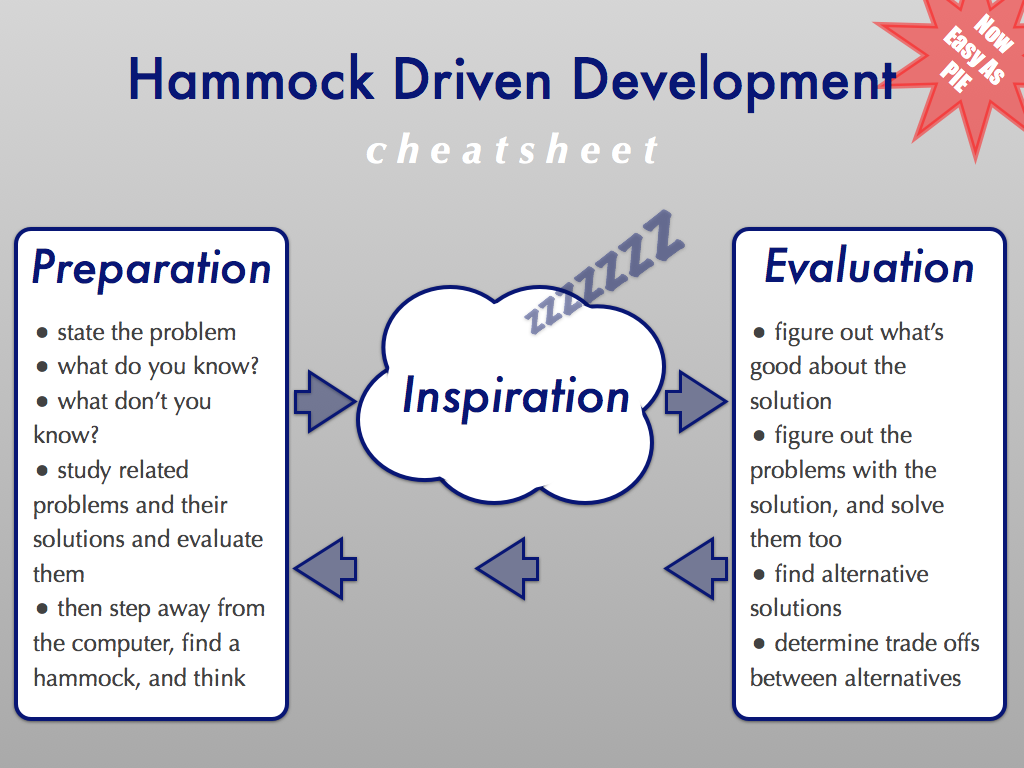
As for testing in Elixir: I wholeheartedly agree with the statement you quoted above from the Udemy Elixir Bootcamp course. Doctests are great as examples and simple unit/regression tests. When you need to test some edge cases that arise in a more complex context, then these tests can better be written in their own test file.
Another thing: Many people that are new to Elixir think that the “Let it Crash” mentality also means to “Let it burn”. But I think that what we actually usually mean is: We write tests to avoid the simple bugs, but we won’t actively look for the Heisenbugs, because these will find you. It is ridiculously hard to spot a Heisenbug, and instead of wasting too much time on this (and still possibly missing one), it is better to just make you application fault-tolerant: prevent it from burning down even if it crashes.

ibgib
For me:
- Unit Tests
- Good for small, self-contained algorithmic functions, especially when enumerating multiple input permutations.
- Fit very nicely with doctests, e.g. in my
IbGib.Helpermodule. - TDD is very well suited for this, but not a hard and fast rule.
- Integration Tests
- What I use most of the time.
- Can test primary workflows (i.e. non-edge cases)
- Can act as examples of how to use a library.
- Often use TDD because it’s a great guide, but again, not a hard and fast rule (especially for more experimental approaches).
- Regression Tests
- If I find any decent, non-trivial bug, always do TDD to clearly define expected behavior.
- Don’t want to ever have a bug happen twice.
- Any decent number of bugs in a given area indicates that more tests are needed, and possibly an architecture/design rethink.

NobbZ
Well it took me really a while to grok this, but I only can sign what you have learned at udemy.
A doctest is not to test you function via documentation, but it is to find flaws in your documentation after changing the API a bit.
Besides of this, my philosophy of testing is varying 
I really do like to test before I implement, but thats not always possible.
At work we do only test a very small subset of critical functions and we do introduce regression tests as soon as there have been known bugs fixed.
In general I realized that I do test much less when I do have a very strong type system, Often I only have one or to tests that test rough behavior (valid input gives valid output and invalid input will throw an exception, stuff like this) while in languages with limited or no compile time types, I do much more testing and even try to do some randomized stress-tests to uncover hidden edge-cases, very similar to property based testing.
Popular in Questions









Other popular topics







Latest on Elixir Forum
Sponsor Spotlight

Catch errors, track performance, monitor hosts and more.
Categories:
Sub Categories:
Forums
Popular Tags
- #ecto
- #liveview
- #troubleshooting
- #learning-elixir
- #deployment
- #library
- #erlang
- #testing
- #genserver
- #mix
- #absinthe
- #remote-other
- #otp
- #plug
- #how-to-question
- #macros
- #postgres
- #channels
- #elixirconf
- #exunit
- #discussion
- #code-sync
- #javascript
- #podcasts
- #onsite
- #dialyzer
- #docker
- #authentication
- #umbrella
- #full-time-contract
- #podcasts-by-brainlid
- #ecto-query
- #elixir-ls
- #phoenix_html
- #iex
- #blog-post
- #graphql
- #genstage
- #ai
- #websockets
- #supervisor
- #advent-of-code
- #elixirconf-us
- #distillery
- #processes
- #forms
- #api
- #metaprogramming
- #security
- #performance
Our Sponsors

Build Elixir applications with speed and confidence.

Supporting innovation across the BEAM ecosystem.

We build reliable cloud platforms for business-critical systems.
Catch errors, track performance, monitor hosts and more.

Error tracking for Elixir devs who love to ship. Start your free account.

Producing high quality Elixir screencasts since 2017.

Enabling companies to succeed by building software people love.

The deployment platform built for Elixir: PaaS ease, VPS control.

The team behind Membrane, Popcorn, LiveDebugger. Available for hire.

Courses that'll move you from confusion to "Aha, now I get it!"