
ancatrusca
Task.async(fn → Rust.performant() end)
Elixir  Rust
Rust
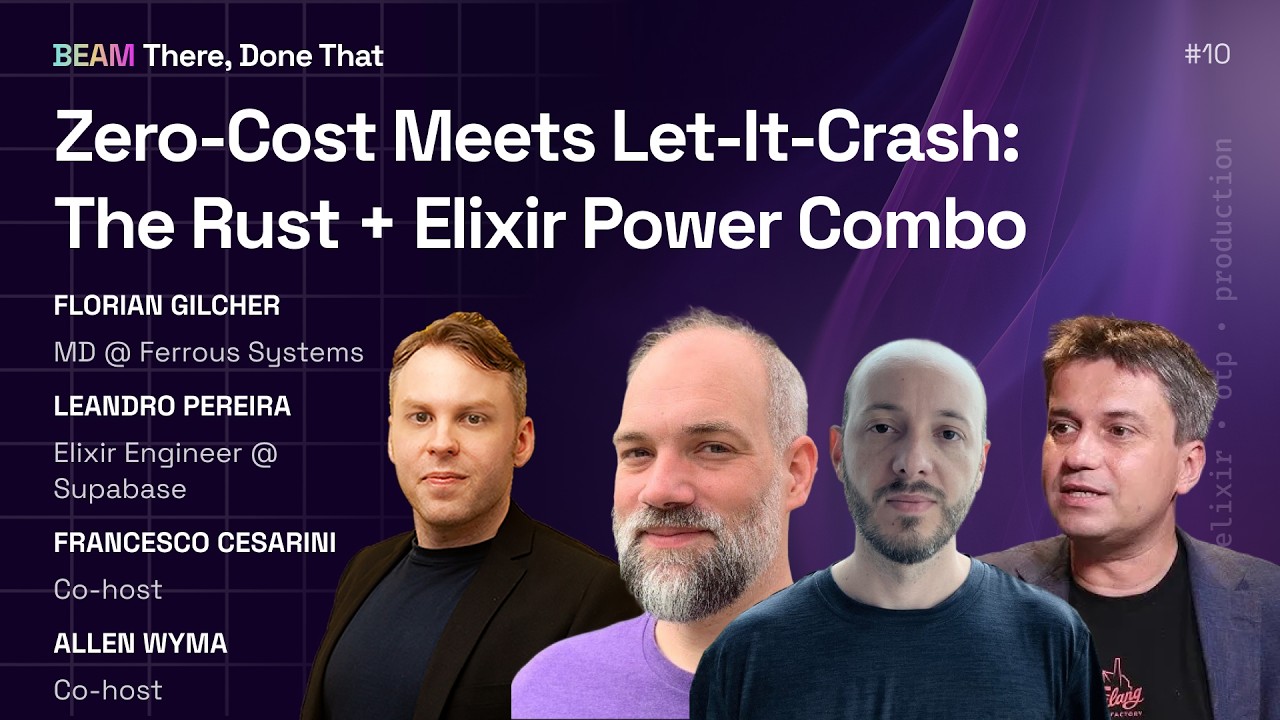
What actually happens when BEAM resilience meets Rust performance?
Florian Gilcher and Leandro Pereira join BEAM There, Done That to talk NIFs, ports, hybrid architectures, and why “just rewrite it in Rust” isn’t always the answer
Where Next?

Trending in Podcasts

Other Trending Topics


Blogs & Podcasts>Podcasts
Latest on Elixir Forum
Sponsor Spotlight

Supporting innovation across the BEAM ecosystem.
Categories:
Sub Categories:
Forums
Popular Tags
- #ecto
- #liveview
- #troubleshooting
- #learning-elixir
- #library
- #deployment
- #erlang
- #testing
- #genserver
- #mix
- #absinthe
- #remote-other
- #otp
- #plug
- #how-to-question
- #macros
- #postgres
- #elixirconf
- #channels
- #exunit
- #discussion
- #code-sync
- #podcasts
- #javascript
- #onsite
- #dialyzer
- #docker
- #authentication
- #umbrella
- #full-time-contract
- #podcasts-by-brainlid
- #ai
- #ecto-query
- #elixirconf-us
- #blog-post
- #elixir-ls
- #phoenix_html
- #iex
- #graphql
- #genstage
- #websockets
- #supervisor
- #advent-of-code
- #distillery
- #processes
- #elixirconf-eu
- #api
- #forms
- #metaprogramming
- #hex
Our Sponsors
Supporting innovation across the BEAM ecosystem.

We build reliable cloud platforms for business-critical systems.

Catch errors, track performance, monitor hosts and more.

Error tracking, logs, uptime, and Just Enough APM. Built for developers.

Elixir, Erlang & BEAM conferences from Code Sync - join us in 2026!

Practical resources that improve the lives of professional developers.

Master modern tools, write cleaner code, and tackle real-world challenges.

The deployment platform built for Elixir: PaaS ease, VPS control.

The team behind Membrane, Popcorn, LiveDebugger. Available for hire.

Courses that'll move you from confusion to "Aha, now I get it!"
Showing Posts 1 to 10- Show Best Posts
- Show All (oldest first)
- Show All (newest first)
ancatrusca
Phoenix feels simple… until you look underneath
Adi Iyengar spent 3.5 years rebuilding Phoenix from scratch to answer one question:
“What is Phoenix actually doing?”
With Francesco and Allen, the conversation dives into Plug, macros, BEAM web history, and why understanding Phoenix internals is what separates senior devs from framework tourists.
Also: why coding agents keep getting Phoenix wrong in 2026

https://youtu.be/jSCo5NvH2jY
FlyingNoodle
I would love to have like a timeline thing so I can jump to different parts of the video. I don’t really have time to watch an entire hour, so I’m more likely to not watch it at all even if there would be bits that interest me.
dimitarvp
Yeah same. I have like 60 Watch Later videos on Elixir and I am slowly making peace with the fact that I am never watching them. They are not brainless TV shows so I can just scroll my phone while they go; I want to pay attention. But even 40 minutes is already a bit much. Maybe a voice-to-text service that then hands it off to an LLM to summarize and find points of interest is the only course of action here…
ancatrusca
Thanks for the feedback. We will add it.
ancatrusca
Thanks. We will work on creating articles from it.
SyntaxSorcerer
Some friendly feedback about the “Building Real-Time AI Agents with Kimutai Kiprotich” episode.
I think the guest missed some really important questions that I wish the hosts would have followed up on.
One in particular was about how to do context reloading after a process crash.
The guest responds by saying, “it’s already in a supervision tree and each agent has its own state. So if it fails, we’ll just restart that agent and it will continue doing so.”
However, there’s no answer to the most important part of this question which is how to reload context.
Does anyone have an answer to this? Super interesting question with important implications for anyone who wants to provide high-quality, long-running agents in an enterprise setting.
Benjamin-Philip
You should also probably create a new Elixirforum (and Erlangforum) thread for each episode. That way you can better organize discussions around each episode. Also more pages might be better SEO.
ancatrusca
Thanks for the feedback Let me get back to you on that.
allenwyma
Hi, this is Allen, one of the co-hosts:
Yes, this was brushed on a bit. I believe Francesco also gave some feedback on how he’s advised to do it before.
In any case: it’s all about recording the last WORKING state, so that way you dont’ get caught into an irreversible crash loop. What that means can depend on your system and how it works. For instance, you can think about a bank statement where it’s append only and you can start from say the “last statement” and replay transactions until you find the one that’ broke it and remove it or something of the sort.
I hope the above can be useful.
allenwyma
Hi, that would be great to do: it’s already a lot of work for me to edit the episodes, themselves.
I’d need to figure out the parts and “chapterize” them which would take some time to think of how I would like to structure it.
In the meantime: I have been going over the video after it’s released and relasing shorts. When we record, I actually record both horizontal AND vertical and I just go back to the vertical recording and “cut cut cut” to produce something like a chapterize version that’s between 30 seconds to 3 mins.
You can see the playlists for each episode on our YouTube page.